




- On sale!
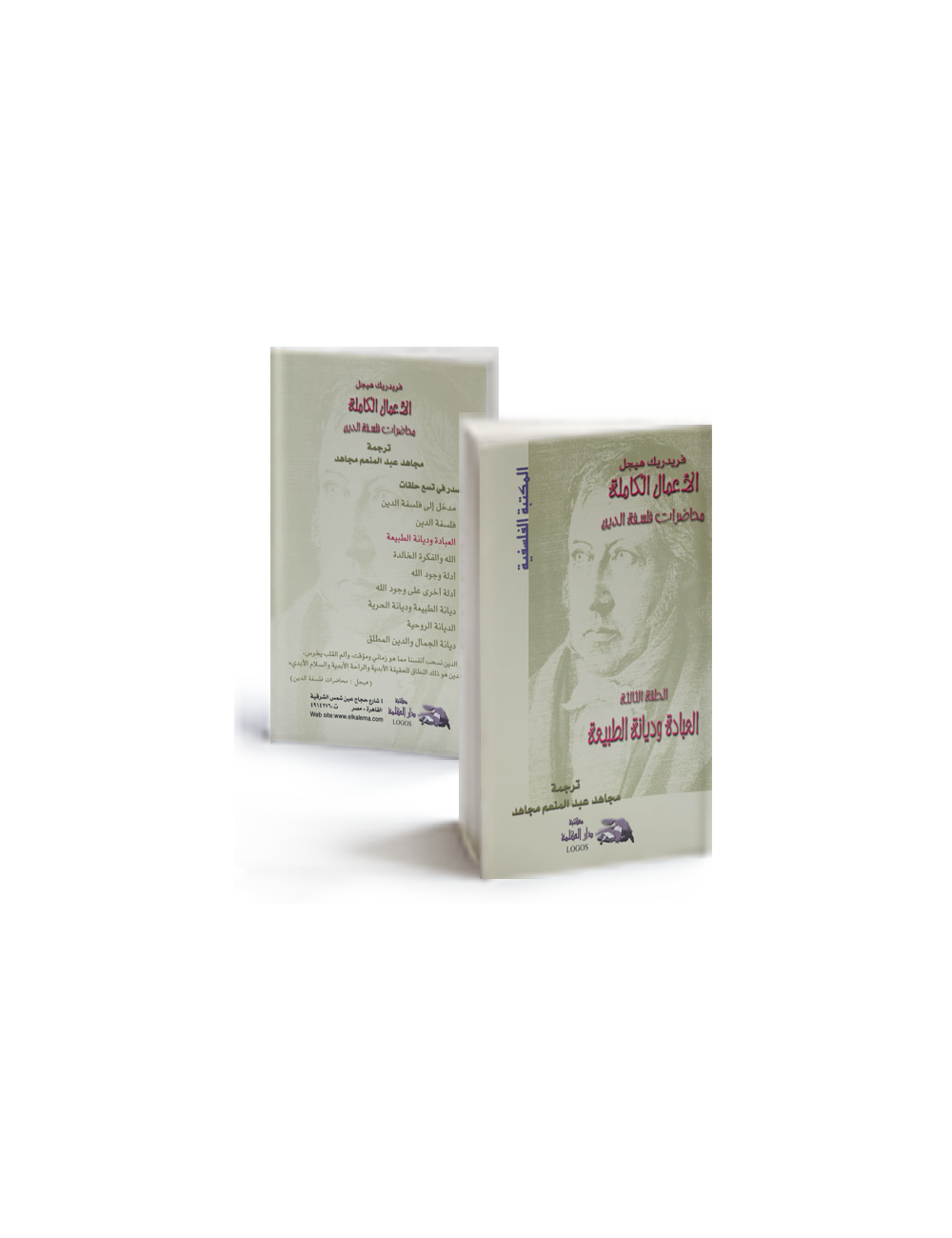
The separation of religion from the subject manifests itself in the emergence of an actual will. In the will I am an actual and free being, and I present myself against the subject as another, in order to represent it with myself by removing it from that state of separation.

Security policy

Delivery policy

Terms And Conditions
But in al-Abida, I stand on the second side, and God is on the first side. God is with myself, and then a concrete unity appears, or if we characterize that first unit or theory as a state under which the existing, objective, normal thought is conceived. Then, in contrast to this second relationship, which is the awareness of God as being present in himself and for his self is, in the form of the ordinary idea, a theory that now constitutes the practical relationship.

Product |

Sale!
Lectures on the philosophy of religion: Worship and the religion of nature
|
 Philosophy does not wear a feminine outfit
|
Sale!
Lectures on the philosophy of religion: The Religion of Nature and the Religion of Freedom
|
 Dynamics of Faith
|
Availability |
In Stock
|
|
in stock
|
In Stock
|
Price |
E£110.00
|
E£110.00
|
E£110.00
|
E£110.00
|
Description |
The separation of religion from the subject manifests itself in the emergence of an actual will. In the will I am an actual and free being, and I present myself against the subject as another, in order to represent it with myself by removing it from that state of separation. |
“A man is not born a woman, a man (becomes) a woman” (4: 156) |
One of the greatest books ever written on the subject, Dynamics of Faithis a primer in the philosophy of religion. Paul Tillich, a leading theologian of the twentieth century, explores the idea of faith in all its dimensions, while defining the concept in the process. This graceful and accessible volume contains a new introduction by Marion Pauck, Tillich's biographer. |
|
ISBN |
977-6010-53-9 | 978-977-384-278-2 | 977-6010-65-2 | 977-384-156-1 |
Author |
Georg Wilhelm Friedrich Hegel | Mejahed Abdelmeaim mejahed | Georg Wilhelm Friedrich Hegel | Paul Tillich |
Translator |
Mejahed Abdelmeaim mejahed | Mejahed Abdelmeaim mejahed | Mejahed Abdelmeaim mejahed | |
Editor |
Mohamed H. A. Ghoneam | |||
Original Language |
English | Arabic | English | English |
Language |
Arabic (Translated) | Arabic (Translated) | Arabic (Translated) | |
Format |
Paperback | Paperback | Paperback | Paperback |
Publishing House |
Maktabet Dar El Kalema Publishing House | Maktabet Dar El Kalema Publishing House | Maktabet Dar El Kalema Publishing House | Maktabet Dar El Kalema Publishing House |
Number of Pages |
192 | 116 | 162 | 176 |
Product Dimensions |
20.2×13.2×0.8 | 21.5×12.3×0.5 | 20.3×14×0.8 | 20×12.4×1.2 |
Product Weight |
182 gm | 130 gm | 158 gm | 152 gm |
By the time James Joyce wrote "The Fengan Awakening" with its broad view of world history, he might have fully felt that quotes like "modern" or "traditional" no longer made sense when applied to his work, but to his old admirers he is above everything else. : Updated like no other.
These 16 sermons contain in concentrated form some of Tillich's most lambent themes. Although they were first published in the early 1960s, the pieces in question take up preoccupations which continue to haunt us at the beginning of the 21st century.
The main characteristic here is subjectivity as a self-determining force - and this subjectivity and rational power that we have met before in the form of the one who has not yet been defined within himself and whose goal - as it appears in the realm of reality - is in this the most specific thing possible.
Paul Tillich was a German theologian and philosopher who moved to the United States after having to flee from Nazis in the 1930s. He became a lecturer at Yale University in Connecticut
Can we run from that which never misses?
Heraclitus asks
In fact, Africa is a vast continent encompassing both geographic variation and tremendous cultural diversity. Each of the more than 50 modern countries that occupy the continent has its own particular history, and each in turn comprises numerous ethnic groups with different languages and unique customs and beliefs.
Burnett explores the influences of Buddhism, Confucianism, and the Jesuits; he looks at the Ming Dynasty and the rise of the Manchus; he assesses the motivations behind Mao, Deng Xaio-Ping, and the current communist and commercial regime. Why is an atheistic leadership seeing a widespread religious revival of several faiths? What is the future of religion in China? A wide-ranging introduction to the ideas, beliefs, and conflicting visions that have shaped modern China.
Here internationally respected depth psychologist, spiritual guide, and personal transformation coach David Benner explores the mysteries of human being and becoming. Drawing on insights from science, philosophy, and forty years of experience integrating psychology and spirituality, he presents concrete steps for living in ways that move us toward wholeness.
"What nonbelievers reject is often not God, but the caricature of God that theologians have synthesized over the centuries. A faith based on that caricature is poorly suited to the hard facts of the real world. These authors masterfully retrace how that caricature was drawn, show where its distortions lie and offer a sound alternative to it."
From one of the most important theologians of the twentieth century, Ethics is the seminal reinterpretation of the role of Christianity in the modern, secularized world.
The Christian does not live in a vacuum, says the author, but in a world of government, politics, labor, and marriage. Hence, Christian ethics cannot exist in a vacuum; what the Christian needs, claims Dietrich Bonhoeffer..
Berdyev's life was nothing but a triangular struggle against the aristocratic environment in which his family belonged and lived in it, against the revolutionary Marxist environment in which he lived during his first youth and against the orthodox environment in which he lived a mature period in a certain sense.
Works of Love is, perhaps, the greatest single piece of literature written in the history of humankind. Astonishingly, it has been greatly ignored by philosophers, laymen, and theologians alike. Unlike its predecessors Works of Love has largely remained unknown in the Western world. In an attempt to introduce my parents to this masterpiece, I discovered that the Russians had not even bothered to produce a translation to this very day! Reading recent reviews written by modern readers—a bare dozen or so—I recognized in their writings precisely how I felt about the book: mesmerized and changed. Most reviewers were both disturbed by the fact that such a life-altering book could have been given a cold shoulder, lasting a swiftly-approaching two centuries.
Hegel's lectures have had as great a historical impact as the works he himself published. Important elements of his system are elaborated only in the lectures, especially those given in Berlin during the last decade of his life.
What can a fingernail tell us about the mysteries of creation? In one sense, a nail is merely a hunk of mute matter, yet in another, it’s an information superhighway quite literally at our fingertips. Every moment, streams of molecular signals direct our cells to move, flatten, swell, shrink, divide, or die. Andreas Wagner’s ambitious new book explores this hidden web of unimaginably complex interactions in every living being. In the process, he unveils a host of paradoxes underpinning our understanding of modern biology, contradictions he considers gatekeepers at the frontiers of knowledge.




Product Comments